If you don't know about Siemens generator/alternator dismantling, assembling, and control principle, this article will show you more.
6.1 Dismantling
This work must always take place in a clean environment containing no dust or moisture.
The cable entry plate must be removed before the generator is actually dismantled. The terminal box must be opened in order to do so, and the exciter cables and bearing thermometer leads loosened.
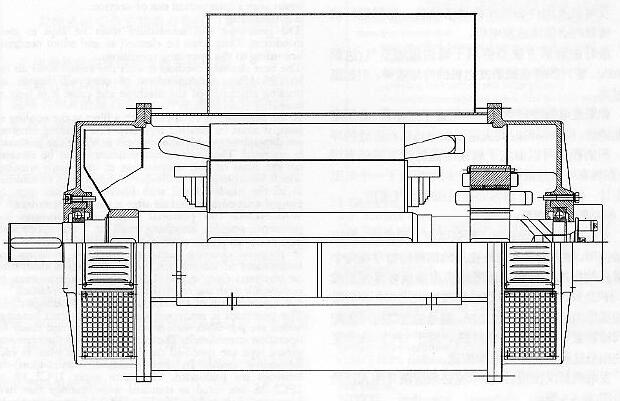
When the bolts adequate have been loosened, the guard over the rotating rectifier can be removed and the three-phase bridge or varistor replaced. When adequate bolts have been loosened, the two bearing can be forced off with the aid of the extraction tool and the tapped holes in the end shields. The bearings can then be inspected or replaced. The stator and rotor windings of the primary machine and the exciter can be checked after the rotor has been lifted out.
6.2 Assembling
The generator must be re-assembled in reverse order. Suitable tools must be used and the use of force avoided. If the generator differs from the basic model, for example if it has a foot flange with two bearings, the dismantling and assembly procedures may deviate from those described here.
An Addendum to the instructions is enclosed with all variants that have an air filter, an air-to-water cooler, a degree of protection other than IP23 or a special type of construction or mechanical design.
7. Control
7.1 General description, control principle
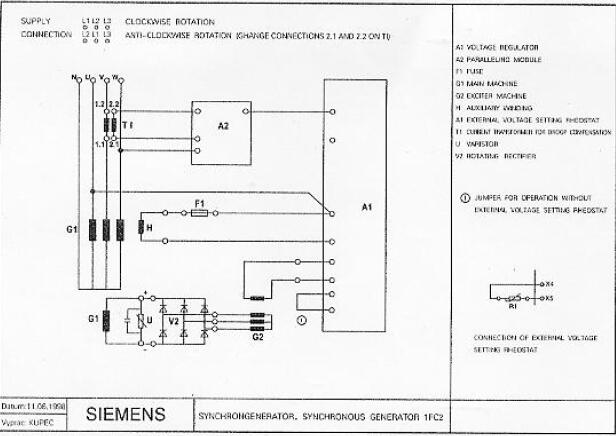
The purpose of the control components is to maintain a constant terminal voltage at the primary machine, irrespective of the load and the power factor. The voltage regulator measures the generator voltage and compares it with the set point. The exciter winding of the exciter obtains the required direct current via the actuator of the voltage regulator, which is supplied by an auxiliary winding inside the stator of the primary machine. The three-phase winding of the exciter feeds the rotor of the primary machine via the rotating rectifiers. The lightning arrester (varistor) limits any voltage peaks that occur there to values within the permissible range.
The voltage regulator in the compact model is insensitive to moisture and vibrations.
The remanence inside the stator of the exciter is sufficiently high to ensure that the generator is self-excited.
7.2 Voltage regulating range
The terminal voltage can be set to ±5.0% of the rated voltage with the potentiometer on the regulator. An external potentiometer (motor-operated on request) can be supplied for remote control.
7.3 Control precision
The static control precision is ±1.0% from no load to full load. This value is also achieved with a constant output and speed variation of up to ±5%. Other control precision are available on request.
7.4 Dynamic voltage states
The temporary voltage dip which occurs when the full load is connected with a power factor cos¢=0.8 is normally 15 to 20%. This value is dependent on the size of the generator. The recovery time varies between 0.3 and 0.8s accordingly.
7.5 Parallel operation
The 1FC2 synchronous generators are suitable for operation in parallel with another generator and with the power system. If they are operated in parallel, the distribution of the active-power load is determined by the prime movers. The speed controllers of the parallel prime movers must be set to the same characteristics curve, in order to ensure that this load is distributed uniformly. They can also be fitted with an electronic load rheostat.
The generators can also be equipped with a reactive-current compensator, to permit parallel operation with an optimum reactive-load distribution. The gradient of the characteristic curve can be adjusted as a function of the reactive current by changing the setting of the droop resistance. The droop is set b the manufacturer to a value of roughly 6%, the maximum setting range being 10% Voltage fluctuations of up to ±2.5% are allowed to occur with this setting when the generator is operated in parallel with the power system, without the maximum reactive current of the generator being exceeded. If the system voltage fluctuates by more than this amount, either the droop must be increased or the terminal voltage must be compensated by means of a power-factor controller.
8. Zero conductor
8.1 General
If the generators are operated in parallel, either with one another or with the power system, interference may be caused by the 3rd order current harmonic appearing in the form of circulating currents. These currents are added to the phase currents and may result in the generators being heated up beyond the maximum permissible temperature. The zero conductor current must not be more the 50% of the rated current. If it is higher, appropriate steps must be taken to limit is, for example by installing a neutral earthing reactor.
Comments
Post a Comment